Diy 100hz mid-bass conical horn (super easy build)
For most of my fellow horn aficionados, my 80hz mid-bass horn is simply too large. It's also too large for my brother's Christian rock band (Pure Fusion) -- since I help set up his gear and manage his sound board, I can't help but agree;^)
So, to that end, I present a smaller, but just as potent 100hz version. This horn is a class act and can be fabricated with greater ease than its 80hz cousin. Like the 80hz horn, it employs a JBL 2240 driver -- they're just wicked sweet -- and has excellent impulse response. I also like the way it merges sonics with the high and low frequency horns, just seamless. We run this particular horn down to 55hz (QSC RMX 2450 filter) and I must say, it does a fine job below 100hz (of course it's rolling off). It's partnered with the Folded bass horn and makes the drummer (my brother) very happy.
To give you an idea of how potent this horn is: I had a pair connected to my brother's PA (one handled stage left, the other was placed along side the folded sub-bass horn on stage right) and for some reason, we weren't getting much bass from the right side of the stage. I discovered that the folded bass horn had been connected out of phase with regard to the mid bass horn. I reversed the polarity and voila, the bass came back strong as a cannon's blast. When you ponder this, the 100 hz horn shouldn't have been able to impact the sub-woofer horn to any great degree if it were incapable of producing bass in the first two octaves--after all, it's a 100 hz horn. Wrong! This horn is a beast, and despite rolling off below 100 hz, it still packs plenty of punch below its cutoff.
Edit: Using a modified set of plans, I just completed a pair of these darlings for my generous neighbor (who lets me use--rent free--his empty warehouse space to build my creations), and in them I installed 15 inch Electro Voice EVM-15L drivers. These little monsters have very lightweight, curve-linear cones coupled to an extremely power motor. The end result is nothing short of amazing. The snap of the drum, or the low-end fill of a trombone is breathtaking. I just finished listening to a Louis Armstrong tune (where he pines away over his dear, cold, dead sweetheart dressed in white) that sounded as if it were recorded today -- stunning realism. My point? JBL isn't the only good sounding driver in this horn, and a 15 inch driver can produce as much SPL as an 18 inch unit. Which one do I like better? In this 100hz horn, with a home audio system, I tend to favor the 15 inch Electro Voice. In a Pro Audio situation, I think the JBL 2240 drivers offer greater bass extension.
You'll definitely want a 2+ octave subwoofer to fill the bottom end, but that's just plain obvious. The folded bass horn is what my brother's using (we intend to employ a stack of four eventually). As for me, I'm still quite content with that big, bad, red tapped-horn in the left corner and the 4 x 18" bass reflex in the right. The power and complete lack of stress generated by this sound system is simply beyond words! It's such a joy to hear this many horns in unison. If you're ever in the neighborhood, look me up and we'll share a listening session.
Important: I use my table-saw to make several bevel cuts that extends beyond 45º and do so by placing the plywood piece on edge. This requires a special fixture that prevents the material being cut from falling into the blade slot. If you're not familiar with table-saw cutting techniques and safety, do not make this cut. Your fingers may be dangerously close to the blade and I don't want to be held responsible for the loss of someone's precious "digits". Seriously!
Rather than perform this dangerous cut, you can always split the miter in two and create a small, thin wedge of material (something other than plywood) to continue the angle past 45º. One of the angles in question is the 35.12º cut where the throat adapter joins the speaker plate. This angle is actually 54.88º, but flip the board 90º onto its side and the angle becomes 35.12º and labeled as such for the sake of simplicity -- I don't want to have to do the table-saw math in the shop when my mind is on the task of cutting the pieces.
So, here's several ideas to help you avoid that crazy cut: Idea #1: begin with a 45º cut on the plywood (which is the greatest angle cut you can get from most table-saws), then glue a sliver to it that has been beveled at 9.88º (10º-). Idea #2: Split the 55º- in two for a couple of 27.5º cuts (27.5º on the primary piece and 27.5º on the sliver). Regardless of which route you take, the combination of the two angles parallels our finished surface to that of the speaker mounting plate. Yes, it's a bit more time consuming, but far safer.
If all this seems too foreign, or dangerous, perhaps you'd like me to fabricate a pair for you?
So, to that end, I present a smaller, but just as potent 100hz version. This horn is a class act and can be fabricated with greater ease than its 80hz cousin. Like the 80hz horn, it employs a JBL 2240 driver -- they're just wicked sweet -- and has excellent impulse response. I also like the way it merges sonics with the high and low frequency horns, just seamless. We run this particular horn down to 55hz (QSC RMX 2450 filter) and I must say, it does a fine job below 100hz (of course it's rolling off). It's partnered with the Folded bass horn and makes the drummer (my brother) very happy.
To give you an idea of how potent this horn is: I had a pair connected to my brother's PA (one handled stage left, the other was placed along side the folded sub-bass horn on stage right) and for some reason, we weren't getting much bass from the right side of the stage. I discovered that the folded bass horn had been connected out of phase with regard to the mid bass horn. I reversed the polarity and voila, the bass came back strong as a cannon's blast. When you ponder this, the 100 hz horn shouldn't have been able to impact the sub-woofer horn to any great degree if it were incapable of producing bass in the first two octaves--after all, it's a 100 hz horn. Wrong! This horn is a beast, and despite rolling off below 100 hz, it still packs plenty of punch below its cutoff.
Edit: Using a modified set of plans, I just completed a pair of these darlings for my generous neighbor (who lets me use--rent free--his empty warehouse space to build my creations), and in them I installed 15 inch Electro Voice EVM-15L drivers. These little monsters have very lightweight, curve-linear cones coupled to an extremely power motor. The end result is nothing short of amazing. The snap of the drum, or the low-end fill of a trombone is breathtaking. I just finished listening to a Louis Armstrong tune (where he pines away over his dear, cold, dead sweetheart dressed in white) that sounded as if it were recorded today -- stunning realism. My point? JBL isn't the only good sounding driver in this horn, and a 15 inch driver can produce as much SPL as an 18 inch unit. Which one do I like better? In this 100hz horn, with a home audio system, I tend to favor the 15 inch Electro Voice. In a Pro Audio situation, I think the JBL 2240 drivers offer greater bass extension.
You'll definitely want a 2+ octave subwoofer to fill the bottom end, but that's just plain obvious. The folded bass horn is what my brother's using (we intend to employ a stack of four eventually). As for me, I'm still quite content with that big, bad, red tapped-horn in the left corner and the 4 x 18" bass reflex in the right. The power and complete lack of stress generated by this sound system is simply beyond words! It's such a joy to hear this many horns in unison. If you're ever in the neighborhood, look me up and we'll share a listening session.
Important: I use my table-saw to make several bevel cuts that extends beyond 45º and do so by placing the plywood piece on edge. This requires a special fixture that prevents the material being cut from falling into the blade slot. If you're not familiar with table-saw cutting techniques and safety, do not make this cut. Your fingers may be dangerously close to the blade and I don't want to be held responsible for the loss of someone's precious "digits". Seriously!
Rather than perform this dangerous cut, you can always split the miter in two and create a small, thin wedge of material (something other than plywood) to continue the angle past 45º. One of the angles in question is the 35.12º cut where the throat adapter joins the speaker plate. This angle is actually 54.88º, but flip the board 90º onto its side and the angle becomes 35.12º and labeled as such for the sake of simplicity -- I don't want to have to do the table-saw math in the shop when my mind is on the task of cutting the pieces.
So, here's several ideas to help you avoid that crazy cut: Idea #1: begin with a 45º cut on the plywood (which is the greatest angle cut you can get from most table-saws), then glue a sliver to it that has been beveled at 9.88º (10º-). Idea #2: Split the 55º- in two for a couple of 27.5º cuts (27.5º on the primary piece and 27.5º on the sliver). Regardless of which route you take, the combination of the two angles parallels our finished surface to that of the speaker mounting plate. Yes, it's a bit more time consuming, but far safer.
If all this seems too foreign, or dangerous, perhaps you'd like me to fabricate a pair for you?
Here you can see the horn I'm building for my brother's band sitting on a protective sheet -- I haven't installed feet on the horn, yet, and don't want to die a horrible death by my wife's hand ;^)
It's no taller than the credenza to its right. You'll notice that this little guy is dwarfed by the 8 foot tall tapped horn to its left.
At the bottom of this page, you can view the smaller cousin of this horn. It uses a B&C 12" driver.
It's no taller than the credenza to its right. You'll notice that this little guy is dwarfed by the 8 foot tall tapped horn to its left.
At the bottom of this page, you can view the smaller cousin of this horn. It uses a B&C 12" driver.
This horn's compression chamber is physically the same as the 80hz horn, but if you'll study the "Input Parameters" you'll notice that the interior space needs to be smaller by about 4 liters. I do this by adding blocking/bracing to the chamber "lid". The entire chamber lid is removable from the speaker plate -- otherwise, you wouldn't be able to install the 18" speaker. You may wish to add bracing where the chamber mounts to the speaker plate and in the corners of the lid. Tune to taste.
As mentioned in the beginning of this piece, when using a table saw, you can create a safer environment for your fingers by splitting the 55º bevel cut into two 27.5º cuts. The idea is captured in the thicker black lines in the following drawing:
Diy 100hz mid-bass bi-conical horn (Challenging build)
Well, there's always a driver that deserves special attention, or manages to grab my attention :-) and when I stumble across that little gem, I'll take a moment to share my discovery.
The driver in my line-of-sight is the B&C 12PE32. This is a 12" mid-bass driver with some serious potential. It's efficiency out of the box is incredible: 6.8%! When you consider that the average driver weighs in at a paltry 2 to 3%, you can see why I'm excited. Also, that wonderful (but discontinued) Electro Voice EVM-15L shares similar effeciency. You can see where this is heading, I'm sure ;-)
If one were to take a pair of these 12" beauties and place them in a 100hz horn, the performance must certainly be equal, or better, than the EV 15" units, yes? I mean, think about it, you have two powerful motors instead of one, and they're both pushing smaller, lighter diaphragms. The transient response could slice notes to the razor thin edge of cognitive belief -- one may even forget they're listening to a recording -- thus enhancing our ability to suspend disbelief. I'm all for that!
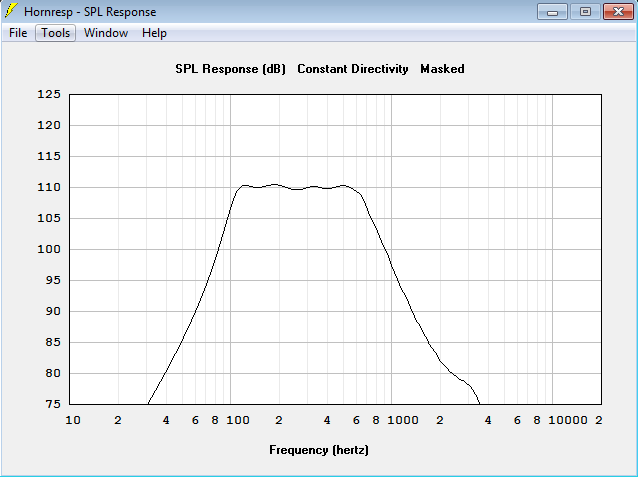
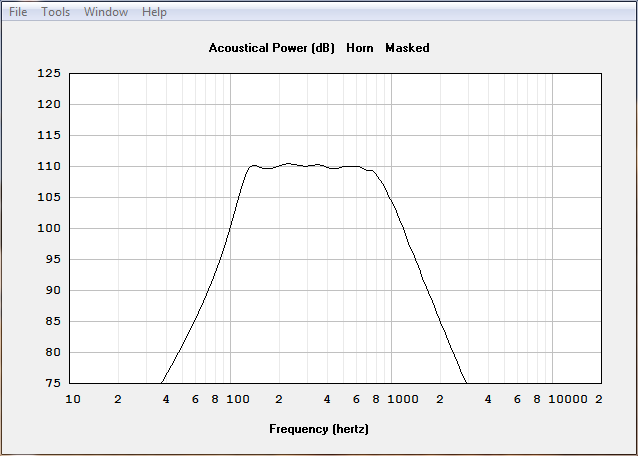
I've only begun to gear up for this quest, so what I have to offer is textbook data only. The simulations look promising -- gauge for yourselves:
The driver in my line-of-sight is the B&C 12PE32. This is a 12" mid-bass driver with some serious potential. It's efficiency out of the box is incredible: 6.8%! When you consider that the average driver weighs in at a paltry 2 to 3%, you can see why I'm excited. Also, that wonderful (but discontinued) Electro Voice EVM-15L shares similar effeciency. You can see where this is heading, I'm sure ;-)
If one were to take a pair of these 12" beauties and place them in a 100hz horn, the performance must certainly be equal, or better, than the EV 15" units, yes? I mean, think about it, you have two powerful motors instead of one, and they're both pushing smaller, lighter diaphragms. The transient response could slice notes to the razor thin edge of cognitive belief -- one may even forget they're listening to a recording -- thus enhancing our ability to suspend disbelief. I'm all for that!
I've only begun to gear up for this quest, so what I have to offer is textbook data only. The simulations look promising -- gauge for yourselves:
In the graph, above, you can see a grayed out line. This line represents a 15" B&C unit. Notice that the B&C 12PE32s are capable of similar bottom end extension, and of equal importance, greater top end extension. The 3db advantage is realized because there are two drivers in parallel.
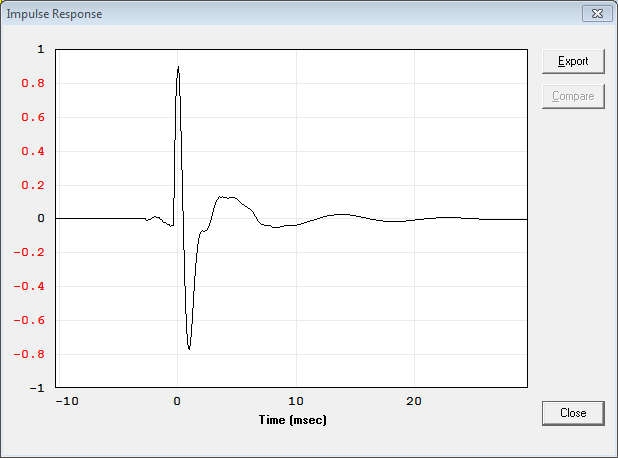
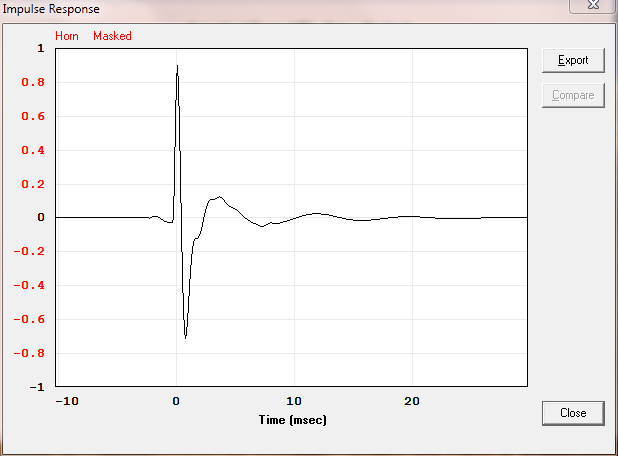
Look at the speed of the impulse in the graph above. The impulse is strong and very quick. I imagine that transients will have a serious edge -- something that brings realism to music.
I've attached a PDF file for your enjoyment, assuming you enjoy studying Thiele/Small parameters.
| bandc_12pe32_12_inch_midbass_driver.pdf | |
| File Size: | 768 kb |
| File Type: | |
Here's a similar horn with one B&C driver:
I've ordered, from Parts Express, four B&C 12JPE32 drivers. I'm going to begin with this single driver horn and see if it delivers all the performance that Hornresp suggests. I'll post results as they arrive. Exciting stuff, yes?
Below, is the rough draft. I've rounded off the angles and calculated the saw cut bevels. The final compression chamber volume can be adjusted by adding wood to the insides of the compression chamber cap.
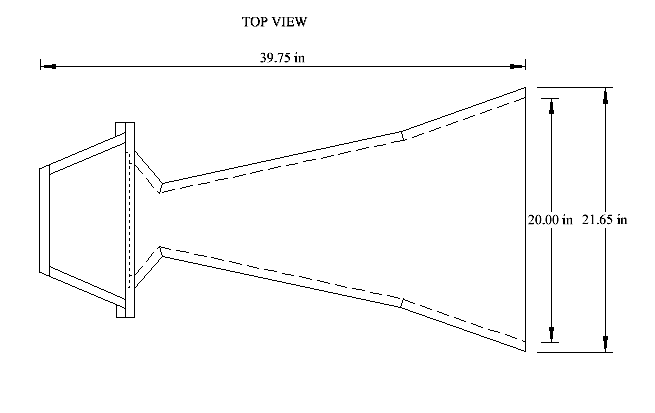
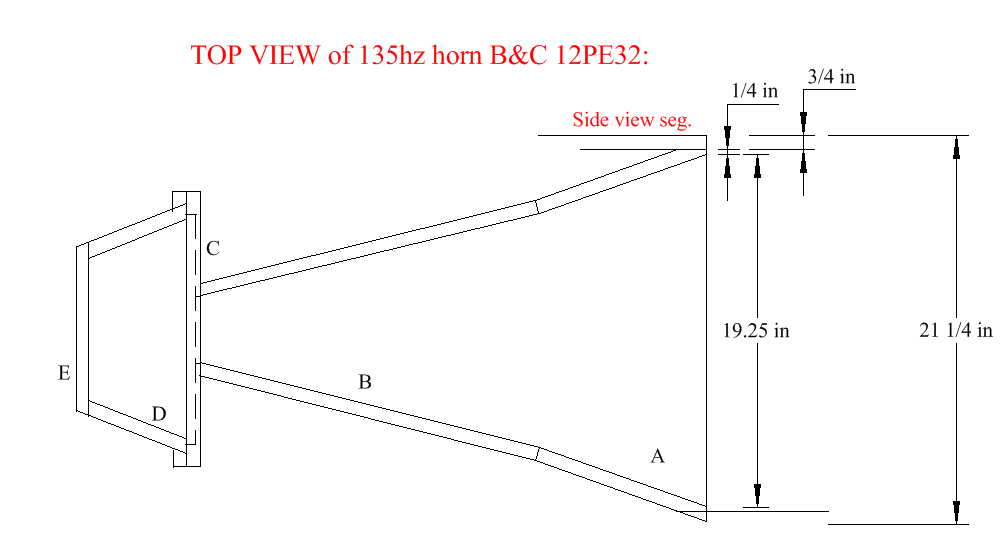
I fabricate the horn by initally treating the drawing as a top view and allowing the horn walls (in the drawing) to become the sides of the actual horn -- all of which are the height of the widest portion of the horn. In this case, the horn walls will be 20" tall, same as the mouth width. You begin by creating a top and bottom that has the drawing laid out full scale, of course you cut the pattern from the plywood before adding the side walls. When you're finished adding the side walls to the bottom pattern, add the top.
(1-21-2012) For you convenience, I've added two view planes: TOP & SIDE. This should make it rather easy to understand my thought process.
Note: When cutting the top and bottom, I leave a tiny bit of material (1/16") on the outsides of the plywood pattern, this way I can route it off clean when the side walls are applied. This make for a lot less sanding and creates an exceptionally good looking product. The speaker baffle plate is 16" wide x 20" tall and will be included in the layout of the top and bottom plywood pieces. You'll add the compression chamber (the chamber that houses the driver) to the back of the speaker baffle plate.
When you're ready to route out the 11-1/8" circular, speaker cutout into the speaker baffle, be sure to take note that the 9" x 9" inside dimension (10-7/8" x 10-7/8" outside dimension) horn adapter is smaller by an 1/8" on all four sides and make allowances. You might consider making the full cutout only 9" in diameter and from there to the 11-1/8" mark only cut partway through leaving plenty of room for cone excursion and material to mount onto the adapter with no air gaps.
After the side walls are completed, and the top and bottom installed, I add the top and bottom horn flares -- they match the SIDE VIEW drawing, below. You have to do a bit of thinking, but it's really not that difficult. The front A flairs have a 16º back bevel saw cut (plywood standing vertically on the saw) where they meet the top and bottom plates. Leave 1/4" lip for strength. Also, you must back bevel the flare edges that mate to the sides of the horn. the B section is back beveled 5º and the A section is back beveled 10º.
There's a bunch more info, but it would take a book to detail. If you're dazed and confused, by all means, email me and I'll explain further.
So, go make some sawdust, add the B&C 12PE32 drivers and tell me what you think.
I fabricate the horn by initally treating the drawing as a top view and allowing the horn walls (in the drawing) to become the sides of the actual horn -- all of which are the height of the widest portion of the horn. In this case, the horn walls will be 20" tall, same as the mouth width. You begin by creating a top and bottom that has the drawing laid out full scale, of course you cut the pattern from the plywood before adding the side walls. When you're finished adding the side walls to the bottom pattern, add the top.
(1-21-2012) For you convenience, I've added two view planes: TOP & SIDE. This should make it rather easy to understand my thought process.
Note: When cutting the top and bottom, I leave a tiny bit of material (1/16") on the outsides of the plywood pattern, this way I can route it off clean when the side walls are applied. This make for a lot less sanding and creates an exceptionally good looking product. The speaker baffle plate is 16" wide x 20" tall and will be included in the layout of the top and bottom plywood pieces. You'll add the compression chamber (the chamber that houses the driver) to the back of the speaker baffle plate.
When you're ready to route out the 11-1/8" circular, speaker cutout into the speaker baffle, be sure to take note that the 9" x 9" inside dimension (10-7/8" x 10-7/8" outside dimension) horn adapter is smaller by an 1/8" on all four sides and make allowances. You might consider making the full cutout only 9" in diameter and from there to the 11-1/8" mark only cut partway through leaving plenty of room for cone excursion and material to mount onto the adapter with no air gaps.
After the side walls are completed, and the top and bottom installed, I add the top and bottom horn flares -- they match the SIDE VIEW drawing, below. You have to do a bit of thinking, but it's really not that difficult. The front A flairs have a 16º back bevel saw cut (plywood standing vertically on the saw) where they meet the top and bottom plates. Leave 1/4" lip for strength. Also, you must back bevel the flare edges that mate to the sides of the horn. the B section is back beveled 5º and the A section is back beveled 10º.
There's a bunch more info, but it would take a book to detail. If you're dazed and confused, by all means, email me and I'll explain further.
So, go make some sawdust, add the B&C 12PE32 drivers and tell me what you think.
This is how I'd cut up 1+ pieces of 4 foot by 8 foot plywood. Click on these pictures to enlarge.
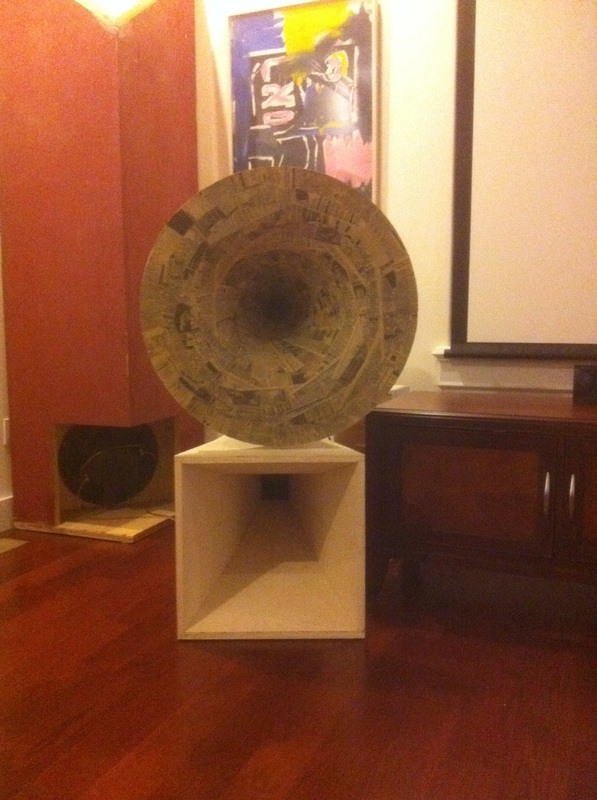
Check out the picture, below: yep, that's what it looks like--pretty small compared to the other horns on this site. Boy does it sound good, though. The drum transients and rim shots are SNAPPY; no other mid bass horn in my array can match it's response. Because it's not as tall, the paper mache horn's axis is in a favorable alignment with my ear, which I find to be a bonus (imaging is more pronounced). The response is also smoother than my other mid bass configurations and has far less distortion.
After a day and night of playing hard, the cone is finally beginning to loosen up and I'm getting more lower mid bass as a result. the sound is becoming more mature (ha, just try to figure out what that means ;-)
Yes, this is going to be the horn I use in my sound system, it's so good. Excellent WAF too.
1/22/2012: I completed the second, matching, 100 hz horn, today, and installed it into my sound system. I turned on the projector/blue ray, loaded up an Eric Clapton concert and set it up for DTS. Wow! Needless to say, I'm in love with the results. The imaging, sound stage, and accuracy all combine to create an immersive experience, one where I'm literally at the concert.
After a day and night of playing hard, the cone is finally beginning to loosen up and I'm getting more lower mid bass as a result. the sound is becoming more mature (ha, just try to figure out what that means ;-)
Yes, this is going to be the horn I use in my sound system, it's so good. Excellent WAF too.
1/22/2012: I completed the second, matching, 100 hz horn, today, and installed it into my sound system. I turned on the projector/blue ray, loaded up an Eric Clapton concert and set it up for DTS. Wow! Needless to say, I'm in love with the results. The imaging, sound stage, and accuracy all combine to create an immersive experience, one where I'm literally at the concert.