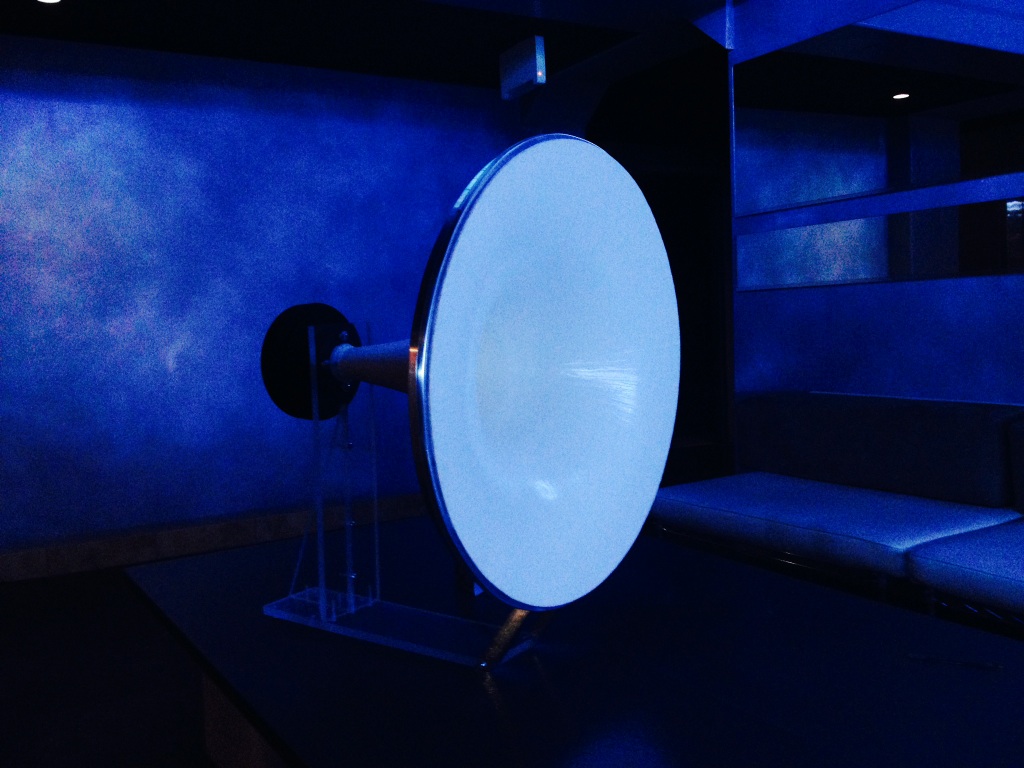
A paper mache horn for class A audio.
Here, in Portland Oregon, we love our music, so whether you own a three watt, class A triode, a 10 watt mosfet follower--or anything in between--it is critical to compliment your sound system with high-efficiency transducers and horns if you desire realistic, powerful sound.
Hello, I'm John Inlow.
Over the years, I've developed a paper mache, tractrix horn that coaxes every nuance these amps can deliver, thus enhancing the musical presentation as if the musician were in your home.
Fabricated with a thirty inch mouth and a body that's twenty-three inches deep (two inch throat version), this horn can carry five-plus octaves of lush, silky music and harmonics. Fabricated with a dozen layers of paper mache for support (think ultra density, high grade plywood), it's well dampened--no ringing, or metallic ilk to jar the nerves--but not overly dampened with the likes of plaster, stone, etc. that sound, to me, like a laser drilling out the eardrums. I've learned through years of experimentation that the perfect medium for a horn isn't always the hardest, the densest, or the strongest. There has to be a certain amount of "give", but this has to be accomplished without adding distortion. Most importantly, everything must sound good, whether it be home theater, jazz, folk or rock.
Versatility:
This horn also works well with one inch compression drivers. I used Tad's 2002 on a project and fell in love with the sound. Unfortunately, they're expensive. The one inch driver's primary advantage is the smaller (hence lighter) diaphragm. Lighter diaphragms lend an airiness to the music whereas two inch compression drivers offer power and slam. It really depends on your music preference as to which driver you use. Rock, heavy metal, large venues, etc. works best with the two inch compression drivers, while classical, folk, and acoustic favor the one inch version.
Performance:
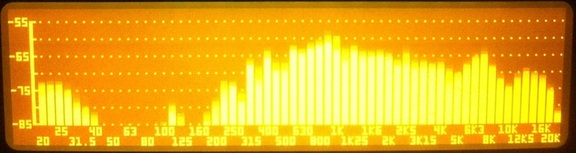
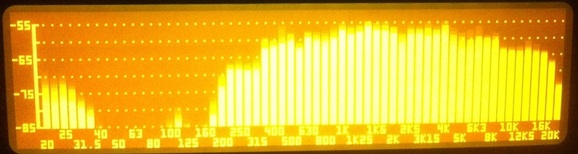
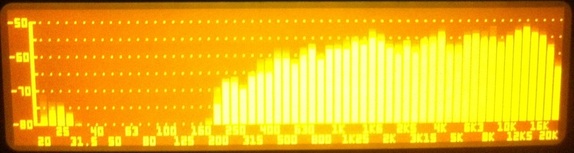
In the picture, below, you can see the RTA frequency range of a pair of two inch throat paper horns with stock JBL 2446 compression drivers operating in stereo format. This test was taken at the listening position, eighteen feet from the horns, with my Behringer Ultra Curve EQ using a calibrated ECM-8000 test microphone running on a thirty-five foot XLR cable. You'll notice that I have decent performance from 315hz to 8000hz with a gradual falling off thereafter due to room anomalies. The sub-harmonic noise on the left of the screen is from the road construction taking place a mile down the road.
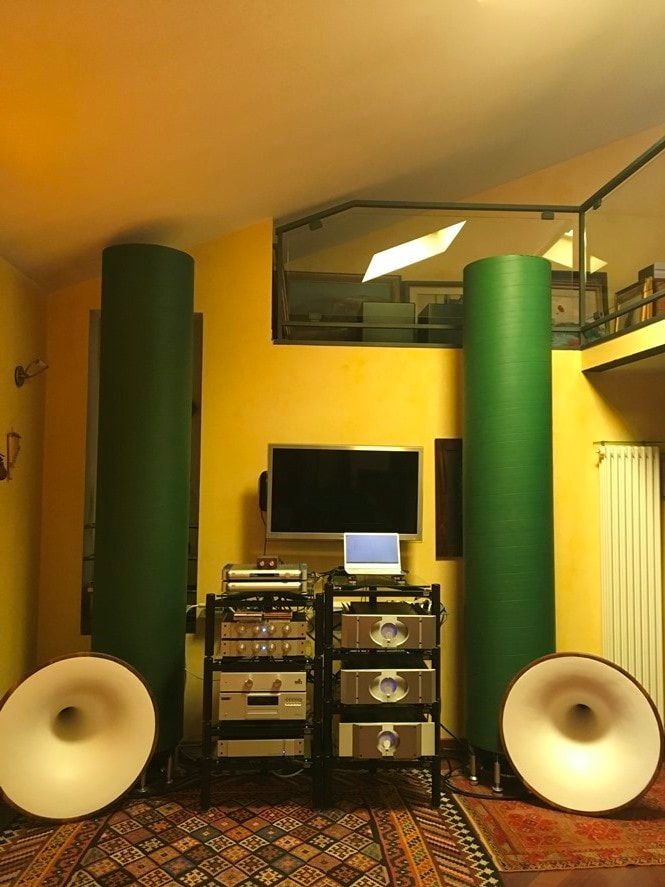
Here's a photo sent to me from a customer in Italy:
Here's a review from a Diy friend, Rahul, that says it all:
After listening to John’s system three or four times, I knew I couldn’t live without the paper horns. I had to have them. So, over the next year we built them together. John was kind enough to lend his time and help, guiding me through the building process.
When I got them home, the first thing I wanted to do was play music. But it’s not easy to get these babies to sound right. First, you must have a good crossover to the woofer. The horns are very sensitive to the crossover and will let you know if something is wrong. Second, the entire system needs to be up to the task. It is easy to spot weaknesses when you have a quality, low distortion system. Third, beware of noise. The horns are about 110db/W, making the tiniest noise sound like a bees’ nest. When dialed in correctly, and backed up by the right equipment, they take you to places you’ve never been.
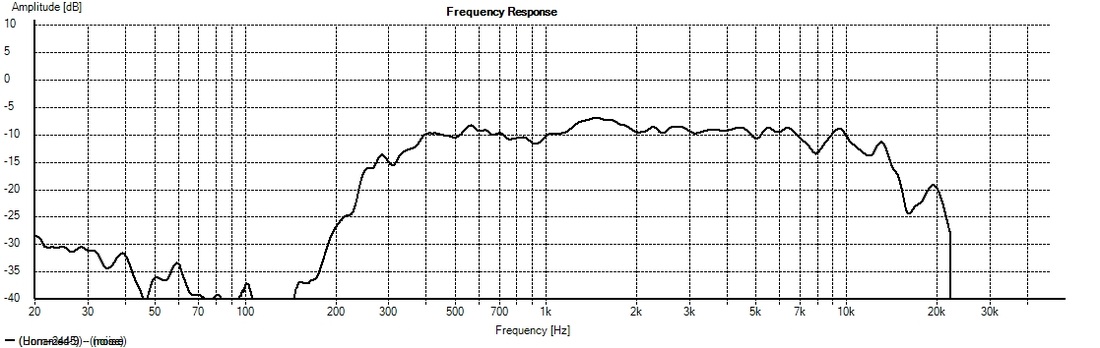
Here’s an on axis measurement of the horn coupled with a JBL 2445J large format compression driver. The measurement is in room, at approximately 1.5 ft with 1/9th octave smoothing, using the swept sine signal in HolmImpulse. The response has not been equalized. The horn reaches down to 300 Hz, as it should, being a 190 Hz tractrix horn. It lies within super +-3db limits from 500 Hz all the way up to 7 kHz. The response is smooth and wide, and rolls off smoothly below 300 Hz and above 10 kHz. The upper frequency limit is purely a function of the driver used, not the horn. A beryllium diaphragm instead of aluminum in this same driver will have a much more extended response. With a little EQ, the response with the aluminum diaphragm can easily be extended to 20 kHz.
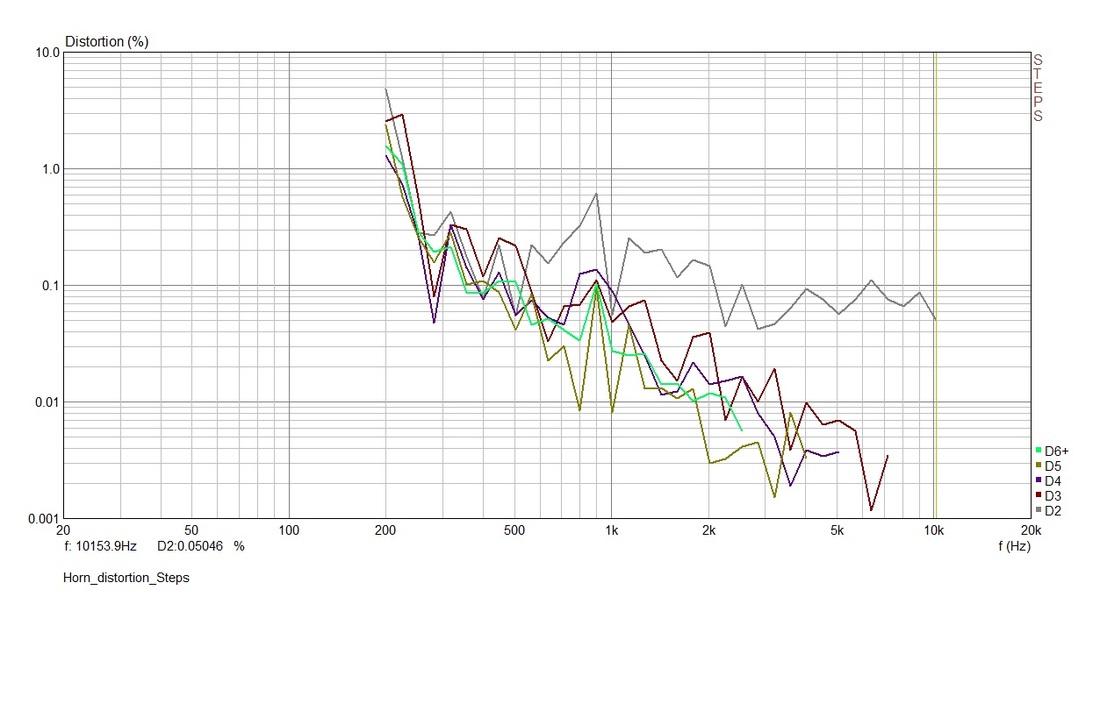
This next graph shows the harmonic distortion, which stays below 0.5% through most of the mid-band. Higher order distortion shows a falling trend, always a good thing. This is superb performance by any standard. Most direct radiators are happy if they are at less than 1% distortion. I believe these two graphs best describe the sound of the horn and compression driver combination: smooth, very low distortion sound.
High power crescendos are delivered with ease. The midrange has a seductive, luscious quality that is very easy to get used to. Vocals have a palpable presence that I’ve never heard before. It sounds BIG. Like real instruments should. The only problem is setting the volume too loud. You can easily be listening at dangerous levels without realizing it.
I compared the horns to a pair of B&W 603s as well as the highly regarded KEF Q900s. These personify the typical bookshelf and tower loudspeakers available in the market today. Both these speakers now sound like toy systems – small, and a pale impression of the music that the horns are able to convey so effortlessly.
Due to the size of horn, it becomes directional at frequencies above 5 kHz. A super-tweeter coming in at 7 kHz or so might be a good solution. However, I haven’t experimented with it yet. I’m too busy enjoying the music.
Once you hear the horns, direct radiators just sound wrong. I’m so glad that I met John and discovered his wonderful horns. He is a great guy and I’ve learned much from him. For those of you who are really interested in music, if you really want to know what a live cello sounds like, or a real voice, or if you want to hear Led Zepp live, get some paper horns. It might be the last speaker you buy.
Thank you John for this wonderful creation!
- Rahul and Greased Lightning ;)
Click here to read Rahul's extended online review.
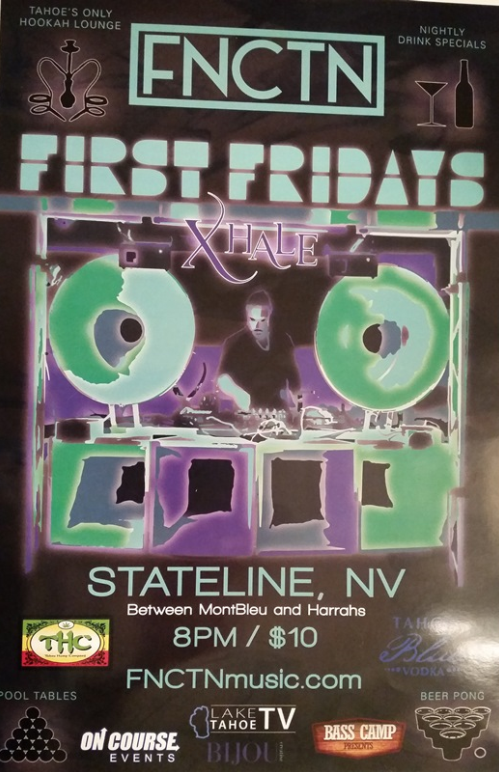
Here's a poster of my system sent to me from a client in Lake Tahoe:
There are better drivers:
Tad 2002 drivers are expensive--new, they cost in the neighborhood of $2200.00. I haven't found used units available on eBay. I'm certain that anyone who own's a TAD isn't about to part company with one of the greatest drivers ever created.
Coming in second place: JBL 2446 drivers are available, new, for $840.00. If you're naturally lucky, you can always purchase a decent pair of 2445, or 2446 drivers, used, off eBay for about one third the cost. I've never encountered a problem with used compression drivers--a testament to JBL quality. Do be aware that you may not be receiving a genuine JBL diaphragm in a used product.
If you want to put that JBL 2446 back into first place: I've recently learned that beryllium diaphragms are being marketed as: Truextent, and are available for around $600.00 (that was awhile back), which means you can have the equivelent of a TAD driver for less than half the cost.
If you're interested in owning a pair of paper horns, or my bass horns -- or anything else on this web site for that matter, please check out my Products page.
One final thought:
In the quest for quality sound, I've discovered there's more than one way to approach a problem. That's why I feel compelled to share many audio topics on this site. We DIYer types seem to have a burning passion, an itch that can't be scratched, and as long as there's another day in our future, another sheet of plywood in the garage, another idea sparking, clawing for life in our brains, our unique social construct will flourish.
Peace, my friend,
John Inlow